When Myth Becomes Memory
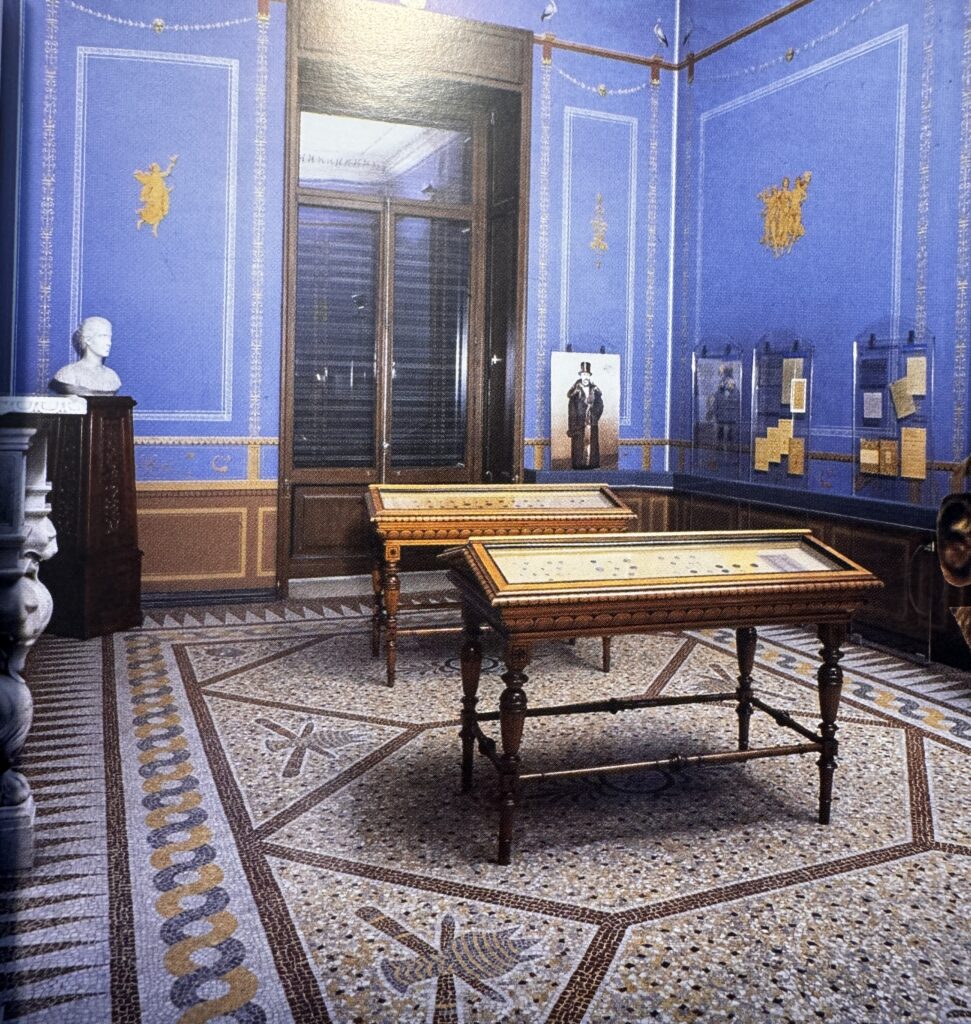 Fig. 1. Exhibition room in the Numismatic Museum. From The History of Coinage, by Despoina Evgenidou, Numismatic Museum of Athens, 2008, p. 11.
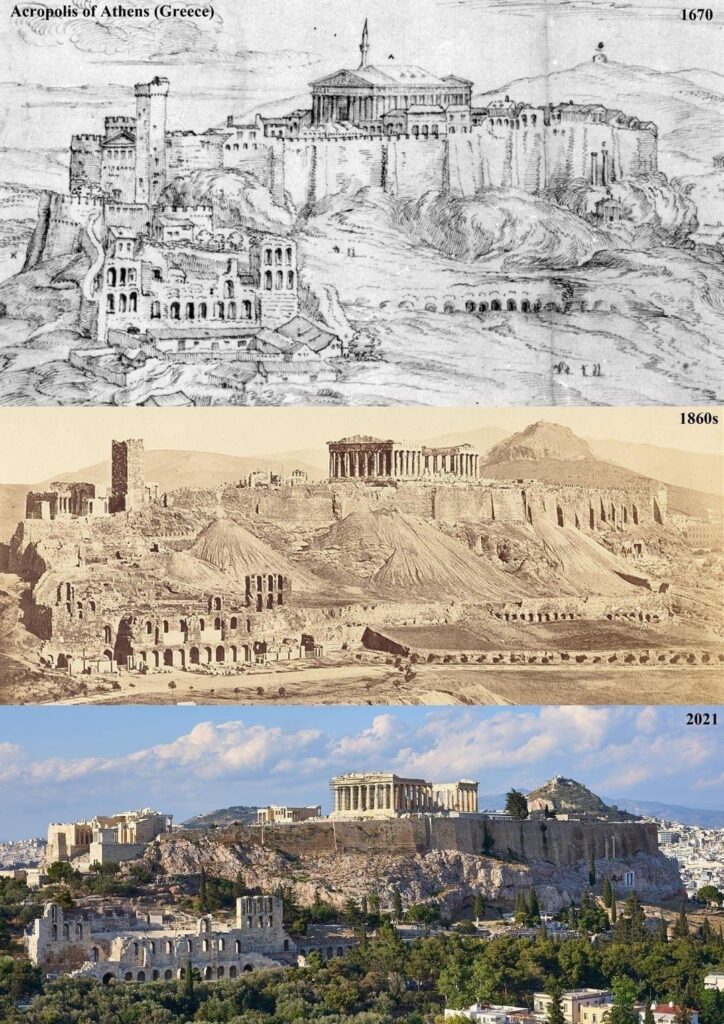 Three historical views of the Acropolis of Athens from 1670, the 1860s, and 2021 showing the changing landscape of the sacred hill.
In “When Myth Becomes Memory,” we follow the thread of Athena across Türkiye’s sacred landscape, from Troy’s legendary battlegrounds to Priene’s civic heights and Assos’s cliffside temple where Aristotle once walked. This journey reveals how myth survives in stone, how memory becomes evidence, and how ancient stories still shape the world beneath our feet.
Myth Becomes Evidence — Troy and the Iliad
We’ve been taught that myth is fiction. The earth tells a different story. For a long time, many believed the Trojan War was only a tale — a poem, a lesson, a myth that lived in dusty books in academic halls but nowhere on the earth. Then Heinrich Schliemann, an outsider without credentials or academic permission, refused the doubt. He didn’t treat Homer’s Iliad as literature; Schliemann treated it as a geography map. He read Homer as instruction rather than metaphor and followed the ancient lines into the soil of western Türkiye until he uncovered ancient Troy. His conviction turned Homer’s legend into evidence, even if he dug too far and misattributed artifacts. Schliemann was simply a man who trusted an old story enough to follow it and in doing so, reminded us that myth leaves traces when someone is willing to look.
But ancient myth doesn’t end at the ruins of Troy; it travels. It moves through time, through cities, through the symbols a people choose to remember themselves by. In Athens, Athena’s myth becomes memory, and memory becomes identity.
Memory Becomes Identity — Athens and the Coins
Athens preserves its identity not only in myth and civic memory, but in the Numismatic Museum, housed in the former residence of Heinrich Schliemann, the man who turned Homer’s lliad into evidence.
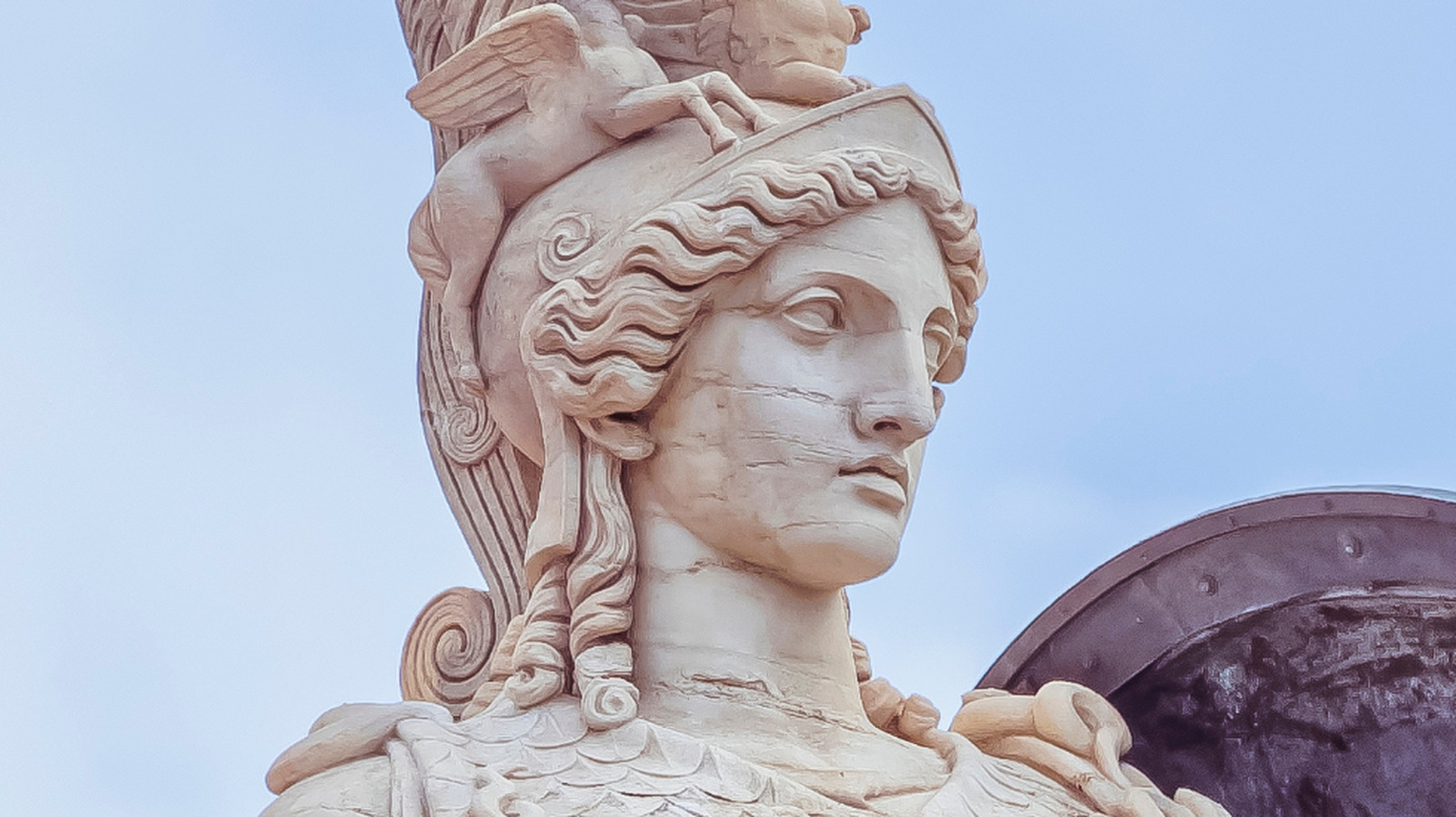
The Numismatic Museum tells this story in coins — thousands of them — each one a small declaration of time, belief, historic moments, and ancient mythic accounts stamped into metal. One gallery is devoted to mythological scenes. Among them, the most meaningful is the contest between Poseidon and Athena for the patronage of the city. Poseidon struck the rock of the Acropolis and produced a saltwater spring; Athena offered the olive tree, a gift of peace, prosperity, and endurance. The citizens chose Athena, and the city took her name.
According to information presented at the Numismatic Museum in Athens:
Under Roman rule, Athens was allowed to strike only bronze coins, but she never placed the busts of Roman emperors on them. Other Greek cities were required to do so, but Athens refused. Whether free or under occupation, the city of Pallas Athena honored her own identity with a steady conviction about her true status. Strength and conviction created continuity in the best and most trying of times. That strength came from the citizenry who saw more than a statue or an acropolis; they saw what it stood for.
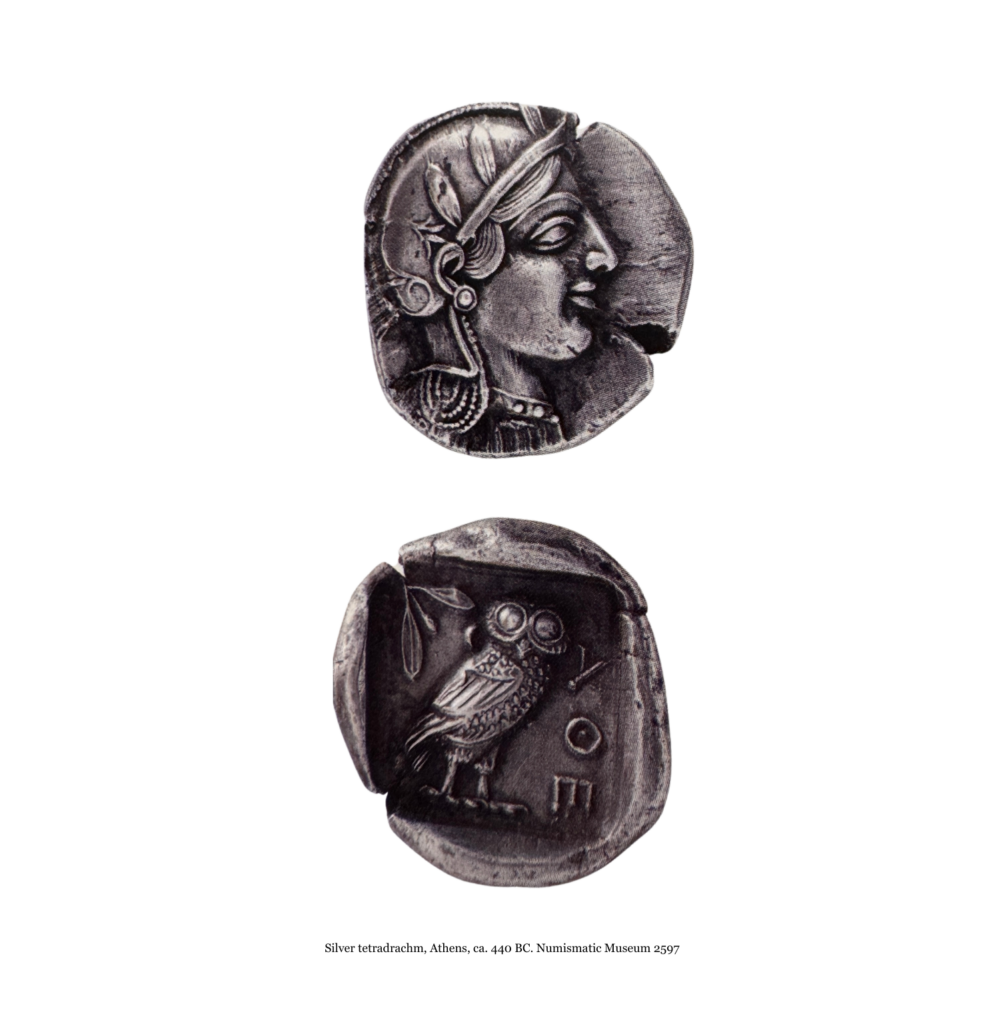
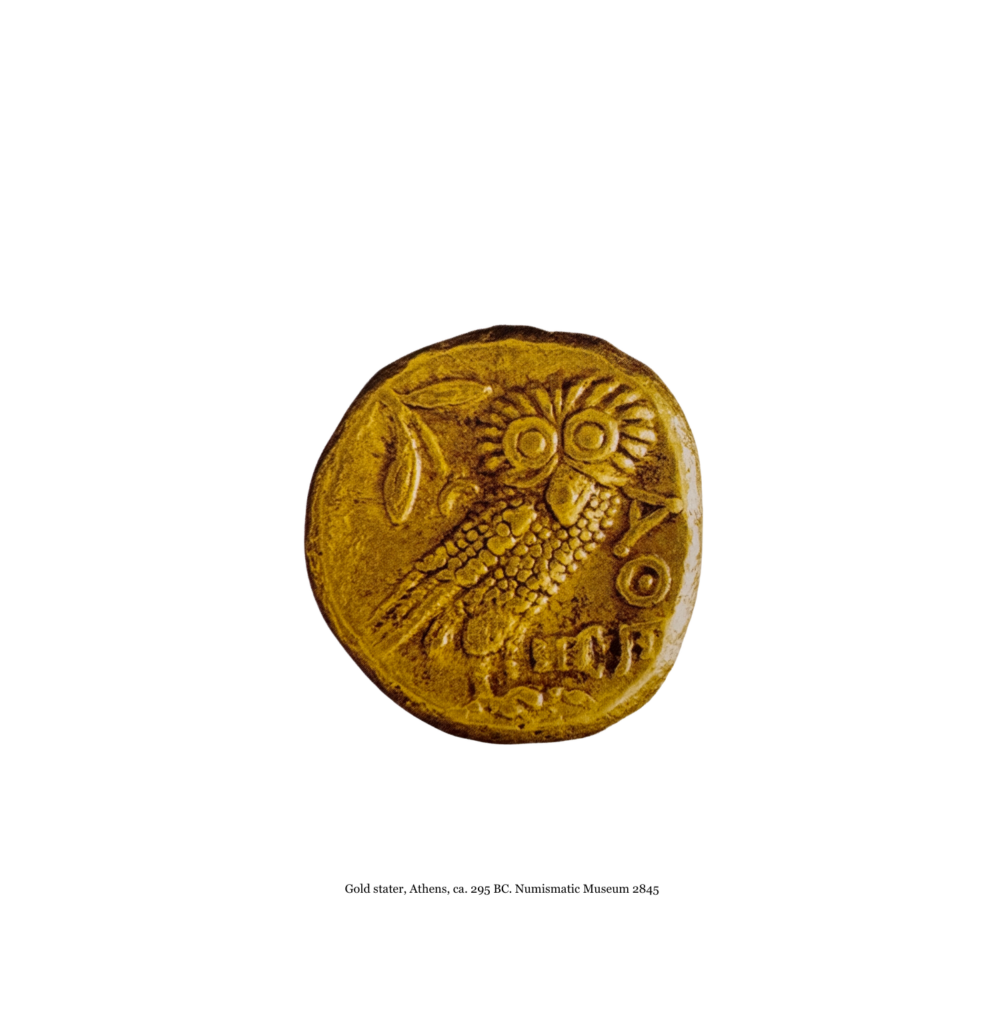
Each object held a story, and each story revealed a belief. Athena wasn’t a distant mythic symbol; she was a living force, honored in temples, impressed onto coins, carried through the routines of daily life, chosen again and again as a reflection of strength and conviction. Her continuity endured not through myth alone, but through the people who chose continuity over conquest.
In 2019, after Starseed Greece Adventure, I stepped into Schliemann’s neoclassical residence named Iliou Melathron, the Palace of Troy. Once filled with the treasures he unearthed from Troy and Mycenae in the 1870s, the building now holds the Numismatic Museum. Walking through those rooms, I felt the certainty of a man who trusted old texts enough to follow them, and the passion he carried for Greek antiquity. On one ceiling, two cherubs depict the faces of Schliemann and his wife, a playful reminder that even the most serious excavators lived with humor. Symbols are embedded everywhere in the décor, waiting for a careful eye to catch their meaning.
And those symbols don’t stay confined to Athens; they echo across the Aegean, carved into temples where Athena’s presence still shapes the horizon. The idea that Athena shaped cities speaks to the ancient conviction that gods acted in the world — a truth of belief, even if she wasn’t the one laying the foundations herself.
Stepping into Athena’s Mythic World — Priene, Assos, and the Odyssey
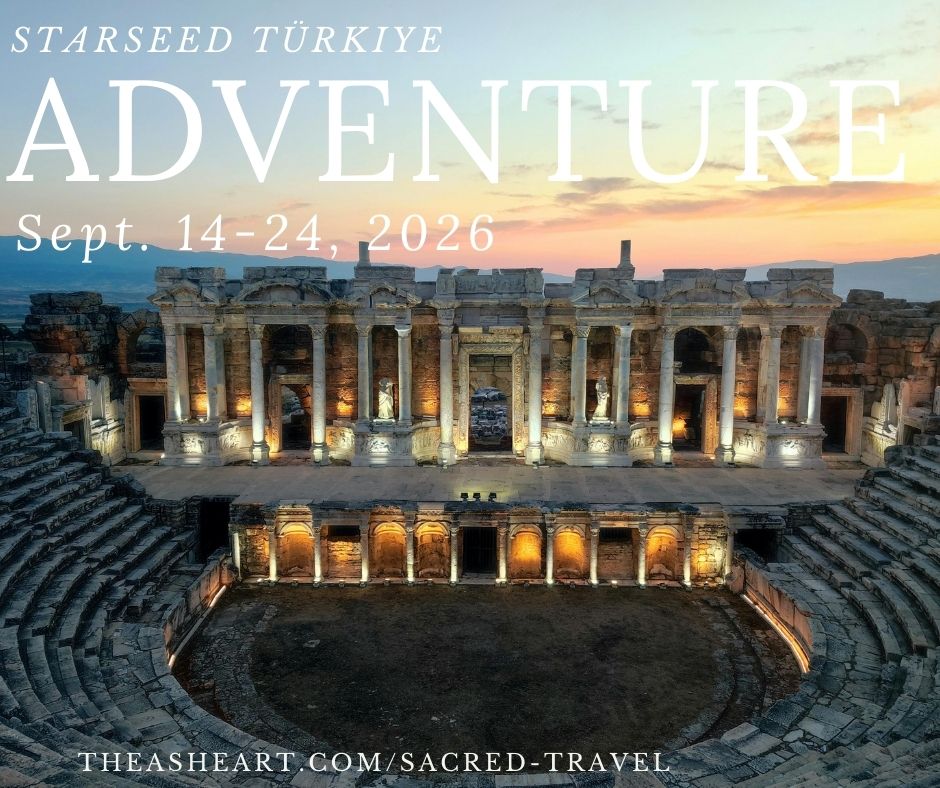
This September, our Starseed Türkiye Adventure continues the discovery into western Türkiye, where Athena’s sanctuaries shaped cities as powerfully as they shaped stories.
At Priene, we will explore Athena’s temple set on a terraced mountainside, where broken columns rise below the famous council seats — the places where civic life literally sat and made decisions. They’re iconic because they show how Priene blended sacred space with civic order: the Bouleuterion just below, the Temple of Athena crowning the ridge — a reminder that wisdom wasn’t only worshipped, it governed. And let’s not forget Alexander the Great: before he swept across Asia and Egypt, the young conqueror dedicated his armor to finance Athena’s temple — staking his destiny on the goddess of strategy and victory.
Athena’s temple at Assos, built around 530 BCE, stands high above the Aegean, watching the same waters that once carried Homer’s warriors toward Troy. Assos lies only twenty miles from that legendary city — close enough for the story to feel present, ancient enough for the centuries to come alive under your feet. Long after Troy’s moment, after the death of Plato, Aristotle would move to Assos, where he lived, taught, married, and forged ideas that would echo through millennia — all beneath Athena’s temple, still active in his time.
Her presence echoed across the region: the sanctuary of Athena Polias in Pergamon, the acropolis shrine in Smyrna (modern İzmir), the temple at Miletus, the sanctuary beside the oracle at Didyma, and the sacred precinct of Athena Ilias at Troy — the goddess honored on the very ground where Homer set the epic, a sanctuary that carried Troy’s memory forward into the Greek and Roman worlds.
For many readers, this whole journey began with a simple spark: hearing that The Odyssey is returning to the screen. Here, myth steps forward again — not from stone or silver, but as an IMAX-sized Athena. The epic begins after the Trojan War, when Homer follows Odysseus on his long journey home and the gods shape his fate. A goddess returning to the collective imagination. A reminder that Homer’s Odyssey continues — nearly twenty-eight centuries later — waiting to be noticed again. And if it doesn’t, well, we still get Zendaya on a cliff looking like she’s about to outthink the universe.
Walk with Me
If “When Myth Becomes Memory” stirred something in you — a curiosity, a recognition, a pull toward the old stories — then walk with me a little further. Myth doesn’t live in books; it lives in places, in footsteps and the lives of the people who dare to follow the thread.
Explore our past, present and future Starseed Adventures, articles, courses by clicking the images. Discover our books on Amazon.


©Thea’s Heart® LLC, 2026 – All Rights Reserved.