After the Course: What Lysimache’s ‘No’ Meant
Lysimache stood at the threshold of Athenian order, holding the architecture of her world in place.
A follow‑up reflection from Architecture of Consciousness: The Priestess and The Pharaoh.
During the teaching of Architecture of Consciousness, I realized how easily Lysimache’s refusal can be flattened when viewed through modern eyes. It is common to interpret her “No” as a personal boundary. It wasn’t. Her refusal carried cultural weight, ritual weight, and the full backing of Athenian civic order.
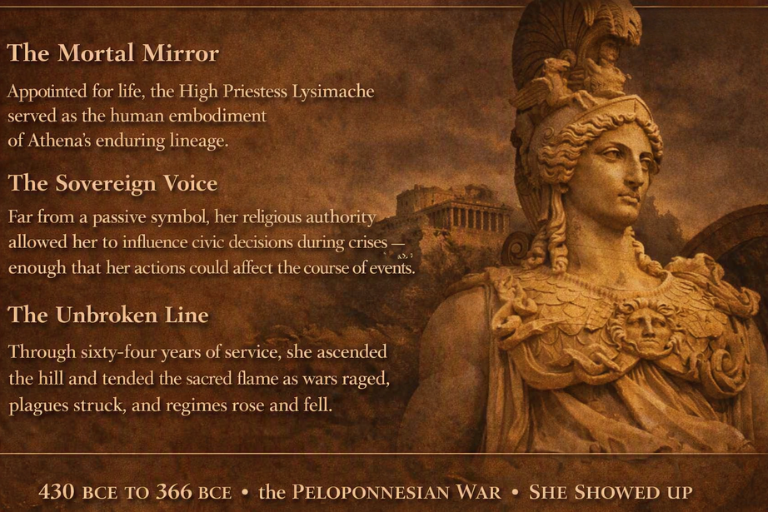
High Priestess Lysimache did not allow a tyrant to enter the Parthenon. She wasn’t defending herself, rather she was defending the architecture she served. Behind her stood the goddess, the polis, and the sacred agreements that shaped Athenian life. Her authority was not individual—it was contextual, inherited, and upheld by the structure surrounding her.
This reflection restores that frame and places Lysimache alongside Akhenaten, the second pillar of the course. Their contrast reveals how power behaves when it is held inside cultural alignment—and how it destabilizes when it steps outside it.
Lysimache and Cultural Alignment
In Athens, Lysimache’s authority made sense because the surrounding structure made sense. Ritual law, shared meaning, and civic coherence shaped the space she worked within. Her clarity came from alignment with context.
When a tyrant marched up to the Parthenon with an army and she said, “No entry,” she didn’t shout, threaten, or negotiate. She stood in the unmoving center of her civic and spiritual authority. Her “No” was backed by the collective sacred agreements of her entire society. To cross her would have been to cross Athena, the polis, and the legitimacy of the tyrant’s own rule.
Her refusal was not personal. It was architectural.
Akhenaten and Cultural Withdrawal
Akhenaten, by contrast, stepped outside the architecture that upheld his sovereignty. In the course, he served as the counterpoint to Lysimache: a figure who withdrew from cultural alignment rather than standing inside it.
When he relocated the royal center to Amarna, he severed himself from the traditional structures that stabilized Egypt. Dismantling the temple system didn’t just alter theology—it dismantled the socio‑economic anchors of daily life. Temple workers, bakers, grain distributors, and administrators lost their institutional sanctuary. Without a collective backstop, the populace dropped into chronic, systemic survival stress.
Akhenaten’s isolation created instability at the foundation of the kingdom. His sovereignty faltered because it no longer rested inside a functioning cultural frame.
A Simple Insight
Lysimache operated inside connection. Akhenaten operated outside it. The outcomes reflected those choices.
Why This Matters Now
Modern life asks people to navigate shifting structures with very little collective scaffolding. It’s easy to assume sovereignty means carrying everything alone. It doesn’t.
When macro‑structures dissolve, the unanchored weight trickles down to the front lines. The overwhelmed clinic receptionist, the panicked professional, the exhausted service worker—these are modern mirrors of the Amarna temple staff. They are trying to carry the cognitive load of a fractured world on an empty tank.
Clarity is strongest when held inside connection, not isolation.
The Architecture of Mutual Exchange
We cannot rebuild the Parthenon, nor can we repair the macro‑temples of the modern world on our own. What we can do is choose where to anchor our connections and construct intentional, local networks of mutual support.
This requires a conscious architecture of engagement:
• Sovereignty is not an invitation for entry without exchange. High‑functioning networks depend on reciprocity. True connection cannot form with people who cross your threshold, sprawl into your space, and consume your time or emotional bandwidth without offering anything in return. Sovereign engagement requires mutual value, respect, and contribution.
• Sovereignty honors the limits of welcome. A healthy structure recognizes when a guest has stayed beyond need. Connection is cyclical. The sanctuary cannot become a receptacle for unmanaged agitation.
• Sovereignty does not negotiate with tyrants. Whether the force is a destabilizing institution or an individual demanding access to your processing capacity without balance, a boundary is not personal—it is structural.
We do not lower the drawbridge for those who seek to consume the space. Like Lysimache, we hold the gate—not out of anger, but to preserve the sanctuary of order, balance, and deliberate truth.
Beyond Lysimache
This reflection expands on themes explored in my course, Architecture of Consciousness: The Priestess & The Pharaoh.
To understand how Athenian devotion to their goddess persisted, even when strained by Roman rule, read my article, When Myth Becomes Memory.
Explore more: • Free Course — The Art of Giving & Receiving
©Thea’s Heart® LLC, 2026 – All Rights Reserved.